
On July 18, 2025, the Cyberspace Administration of China (“CAC”) issued an announcement (“Announcement”) launching a mandatory online registration system and requiring “personal information processing entities” (equivalent to “data controller” under EU’s General Data Protection Rules) that process personal information of one million or more individuals to report the details of their personal information protection officer (“DPO”) through the “Personal Information Protection Business System.”
This development follows the finalization of the Measures for Personal Information Protection Compliance Audits (“Audit Measures”), effective May 1, 2025, which clarified the DPO responsibilities in conducting audits and confirmed the appointment threshold (i.e., 1 million individuals).
The obligation to appoint a DPO has been in place since China’s Personal Information Protection Law (“PIPL”) took effect in 2021. Under the PIPL, entities processing data that exceeds “a certain volume” are required to appoint a DPO and to report certain information about the DPO — to include name and contact information — to CAC. However, the specific threshold triggering this requirement was not defined until the release of the Audit Measures in February 2025. The Announcement now provides further detail on the reporting process.
The chart below outlines the key requirements regarding the DPO reporting.
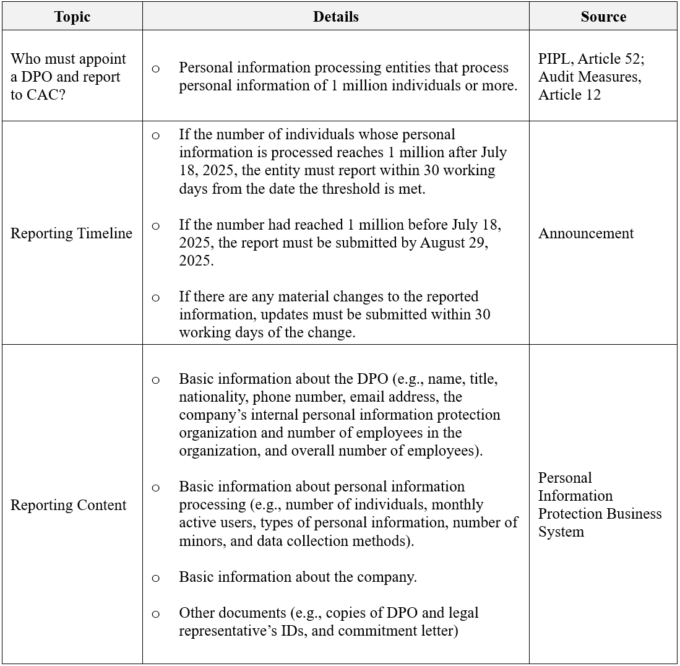
Notably, the DPO is responsible for carrying out personal information protection compliance audits according to the Audit Measures. Under the Audit Measures, large-scale data processing entities (defined as those processing personal information of more than 10 million individuals) must conduct audits at least once every two years. Other data processing entities are required to carry out audits “regularly,” with non-binding guidance suggesting a frequency of once every five years as a good practice.
As part of the audit, the following aspects related to DPO appointment should be assessed:
- Whether a system has been established to evaluate the performance of the DPO and relevant personnel;
- Whether the DPO has relevant work experience and expertise, and is familiar with personal information protection laws and administrative regulations;
- Whether the DPO has clear and defined responsibilities and is granted sufficient authority to coordinate internally;
- Whether the personal information processing entity publicly discloses the contact information of the DPO and submits the DPO’s details — including name and contact information — to the regulator.
Failing to appoint a DPO upon meeting the threshold, or to comply with the associated reporting obligations, constitutes a violation of the PIPL. Companies processing large volumes of personal information in China should promptly assess whether they meet the 1 million individual threshold and, if so, take steps to complete the reporting.