As governments increasingly focus on cloud security and sovereignty, the European Commission (“EC”) is, through its proposal for a Cloud and AI Development Act (“CADA Proposal”), attempting to create a regime establishing “sovereignty” requirements on cloud computing service providers that can be procured by the public sector.  In our prior blog post, we discussed the proposed regime in greater detail.  This proposed regime shares some characteristics with U.S. regimes for government contractors.  However, while similarities exist, there are also meaningful differences.  Existing and potential government contractors providing cloud services and operating in both the United States and European Union (“EU”) may be interested in understanding how existing U.S. requirements compare to the CADA Proposal — which requirements carry across regimes and which requirements are net new.

In this blog post, we provide a brief overview of (1) the CADA Proposal and certain existing U.S. frameworks, namely (2) the U.S. foreign ownership, control, or influence (“FOCI”) regime and (3) the U.S. Federal Risk and Authorization Management Program (“FedRAMP”).  The overview is followed by a high-level comparison of these frameworks. The comparison below focuses on the scope of the respective frameworks and their treatment of provider location, data residency, foreign-government access, and the potential for foreign control to affect service continuity.  This discussion focuses principally on the FedRAMP Rev. 5 framework.

CADA Proposal

The CADA Proposal sits at the heart of the EC’s broader Tech Sovereignty Package and aims to address what the EC perceives as two critical vulnerabilities in the EU’s digital landscape: a structural deficit in data center capacity and a dependence on a limited number of non-EU cloud computing service providers.  If enacted, among other things, contractors would be required to meet the requirements of the CADA Proposal in order to provide cloud services to public-sector bodies operating in certain sectors (at the national, regional, local, and municipal government level).  The cloud sovereignty framework established by the CADA Proposal creates four “Union Assurance Levels” (“UALs”), where UAL 1 presents the least restrictive requirements and UAL 4 presents the most restrictive requirements.

FOCI Regime

The existing U.S. FOCI regime, which is governed by the National Industrial Security Program Operating Manual (“NISPOM”), 32 C.F.R. Part 117, applies principally in connection with U.S. government contracts or agreements that require a contractor to access classified information and therefore require the contractor to obtain a facility security clearance (“FCL”).  The FOCI regime applies when there is access to classified information by a contractor regardless of the nature of the product or service. The FOCI regime is intended to mitigate the risk of unauthorized access by foreign persons to classified information through companies performing on U.S. government contracts as well as prevent foreign persons from adversely affecting those companies’ performance on classified contracts.  To obtain an FCL, or to maintain an FCL following certain material changes to the business (e.g., a change in ownership), a contractor must submit information about foreign ownership and other relationships and undergo an assessment for FOCI.  If the U.S. government identifies FOCI, the U.S. government will require the contractor to implement mitigation measures, assuming mitigation is feasible, prior to granting the contractor an FCL to perform on the contract or to continue performing on existing classified contracts.   (Note that a FOCI mitigation determination is based on a risk assessment reflecting multiple factors.  There may be circumstances where mitigation is not feasible, including due to the sensitivity of the assets or risk profile of the source of FOCI.)

Of note, Section 847 of the Fiscal Year 2020 National Defense Authorization Act (“NDAA”) would extend the concept of FOCI mitigation to certain unclassified Department of War (“DoW”) contracts and subcontracts valued above $5 million.  More information on the forthcoming regulations implementing Section 847 is available in our client alert here.

FedRAMP

FedRAMP provides a standardized security assessment and authorization framework for cloud services that process or store unclassified U.S. government information on behalf of a U.S. federal agency, subject to specified exclusions.  In order to provide cloud services to most U.S. federal agencies, a contractor must comply with the FedRAMP requirements and obtain a FedRAMP authorization.

Comparison of Frameworks

Scope of Application

The three frameworks differ in terms of the government entities they apply to, the flexibility that they afford to address risks, and the nature of how the requirements apply.  Specifically, all three frameworks apply at the federal or national level, but the CADA Proposal would apply more broadly to cloud services procured by public-sector bodies across the EU, including not only national but also regional, local, and municipal government authorities that are responsible for various types of critical infrastructure (e.g., various types of transport infrastructure, healthcare, drinking / waste water operations, postal services, waste management, and research).  Additionally, the CADA Proposal would impose a wide range of obligations on cloud computing service providers in order for them to be certified to a particular UAL, whereas the FOCI regime and FedRAMP expressly govern contractor eligibility and foreign ownership, control, or influence risks, or assess the security of a particular cloud service offering, respectively.

Substantive Obligations

In addition to the differences in the scope of application, the frameworks also differ in terms of substantive obligations, notably including differences in their treatment of foreign ownership and control, as discussed further below.  Below we provide a non-exhaustive list of some of the key differences between those substantive obligations, focusing on issues related to the location of the provider, data residency, and the ability of foreign governments to access data / disrupt services.

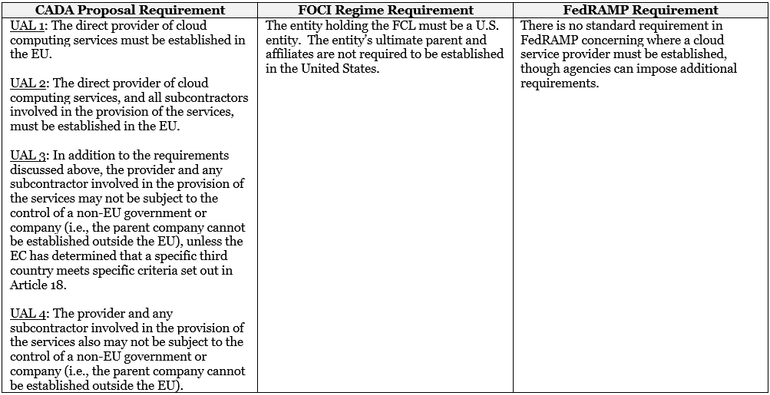
  • Location/Ownership of Provider: The CADA Proposal generally requires the provider, relevant subcontractors, and supporting infrastructure to be located in the EU.  With respect to the FOCI regime, only a U.S. entity may hold an FCL, but foreign ownership or control of a cleared U.S. entity is generally permitted, subject to the feasibility of mitigating identified FOCI.  By contrast, FedRAMP does not currently have any standard restrictions on the location/ownership of the corporate entity providing services.  A few exemplary requirements are shown below.
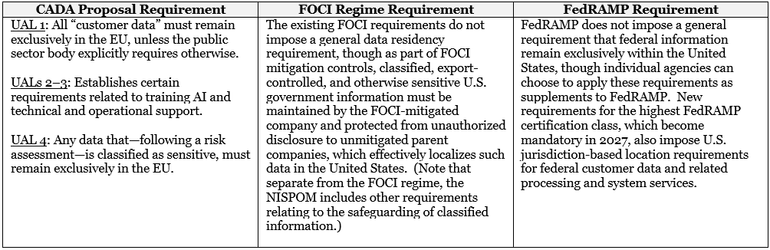
  • Data Residency: The CADA Proposal imposes broad EU data residency requirements across all UALs.  FedRAMP generally does not impose comparable requirements, although forthcoming requirements for the highest certification class impose certain U.S. jurisdiction-based location requirements and federal agencies can impose more specific residency requirements.  Individual DoW contracts may impose additional U.S. data location requirements.  While the FOCI regime does not categorically impose a data residency requirement, required mitigation may effectively localize data within the United States.  A few exemplary requirements are shown below.
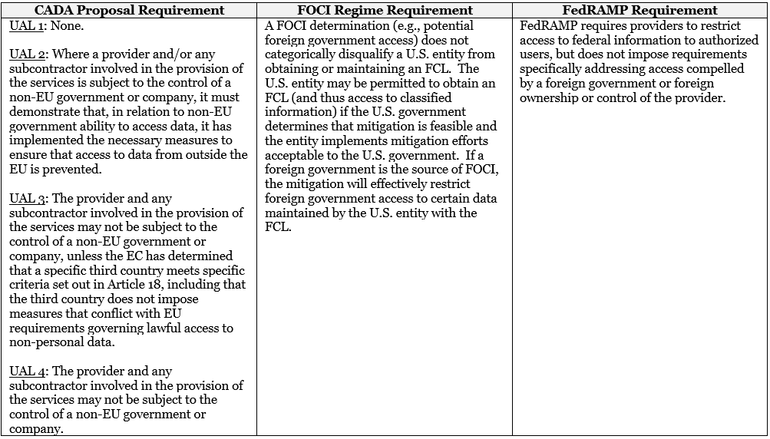
  • Foreign Government Access to Data:The CADA Proposal restricts qualification for UAL 2 unless a provider can demonstrate that it has implemented the necessary measures to ensure that access to data from a non-EU government is prevented.  A provider that is subject to foreign control is disqualified based on non-EU control at UALs 3 and 4, although a provider controlled outside the EU may qualify for UAL 3 if the applicable third-country laws meet specified standards, including that the third country does not impose measures that conflict with EU requirements governing lawful access to non-personal data.  The FOCI regime assesses the particular FOCI risk and may permit that risk to be addressed through entity-specific mitigation that may limit foreign government access to data maintained by the U.S. company.  FedRAMP does not restrict provider access or control.  A few exemplary requirements are shown below.
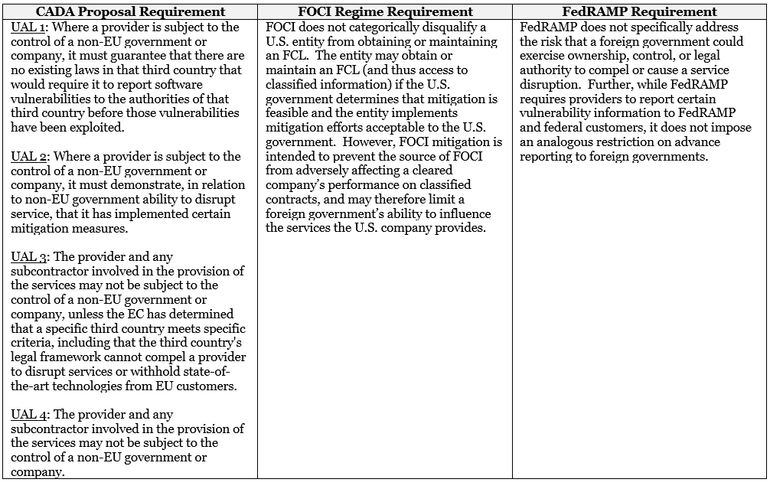
  • Foreign Government Ability to Disrupt Service: The CADA Proposal contains specific requirements addressing the risk that a non-EU government or company could disrupt cloud services.  For certification to UALs 1 and 2, the CADA Proposal requires cloud service providers to take steps to minimize the potential impact of that foreign control in certain domains.  For certification to UAL 3, specific laws in a foreign country (e.g., a requirement that the EU provider comply with restrictive measures from the non-EU country such as sanctions or export controls) prevent a company from even being considered as a potential service provider; although, a provider controlled outside the EU may qualify for UAL 3 if the applicable third-country laws meet specified standards, including that the third country’s legal framework cannot compel a provider to disrupt services or withhold state-of-the-art technologies from EU customers.  Foreign control is an absolute barrier to certification to UAL 4.  By contrast, the FOCI regime addresses identified risks through entity-specific mitigation.  FedRAMP addresses service disruption through cybersecurity controls, not specific restrictions on foreign ownership or control.  A few exemplary requirements are shown below.
Print:
Email this postTweet this postLike this postShare this post on LinkedIn
Photo of Ashden Fein Ashden Fein

Ashden Fein is co-chair of Covington’s Data Privacy and Cybersecurity Practice. He advises clients on cybersecurity and national security matters, including crisis management and incident response, risk management and governance, government and internal investigations, and regulatory compliance. Ashden also serves as lead counsel…

Ashden Fein is co-chair of Covington’s Data Privacy and Cybersecurity Practice. He advises clients on cybersecurity and national security matters, including crisis management and incident response, risk management and governance, government and internal investigations, and regulatory compliance. Ashden also serves as lead counsel in criminal, civil, and internal investigations involving cybersecurity, insider risk, and U.S. national security issues.

Ashden regularly counsels clients on preparing for and responding to cyber-based attacks, assessing security controls and practices for the protection of data and systems, developing and implementing cybersecurity risk management and governance programs, and complying with federal and state regulatory requirements. Ashden frequently supports clients as the lead investigator and crisis manager for global cyber and data security incidents, including data breaches involving personal data, advanced persistent threats targeting intellectual property across industries, state-sponsored theft of sensitive U.S. government information, extortion and ransomware, and destructive attacks.

Ashden also assists clients from across industries with leading internal investigations and responding to government inquiries related to U.S. national security and insider risks. He frequently represents government contractors in False Claims Act matters involving cybersecurity and national security. Additionally, he advises aerospace, defense, and intelligence contractors on security compliance under U.S. national security laws and regulations including, among others, the National Industrial Security Program (NISPOM), U.S. government cybersecurity regulations, FedRAMP, and requirements related to supply chain security.

Before joining Covington, Ashden served on active duty in the U.S. Army as a Military Intelligence officer and prosecutor specializing in cybercrime and national security investigations and prosecutions — to include serving as the lead trial lawyer in the prosecution of Private Chelsea (Bradley) Manning for the unlawful disclosure of classified information to Wikileaks. Ashden is a retired U.S. Army officer.

Photo of Heather Finstuen Heather Finstuen

Heather Finstuen has extensive experience advising clients on cross-border investment and U.S. national security matters, negotiating and implementing mitigation agreements, and leading internal investigations and responding to government inquiries related to U.S. national security risks. Clients regard Heather as “very thoughtful” and “superb…

Heather Finstuen has extensive experience advising clients on cross-border investment and U.S. national security matters, negotiating and implementing mitigation agreements, and leading internal investigations and responding to government inquiries related to U.S. national security risks. Clients regard Heather as “very thoughtful” and “superb at translating legal requirements to business realities” (Chambers USA).

Heather represents domestic and international companies in numerous industries in securing the approval of the Committee on Foreign Investment in the United States (CFIUS). She frequently advises clients on national industrial security program regulations and engages with the Defense Counterintelligence and Security Agency, the Department of Energy, and other cognizant security agencies on the determination and mitigation of foreign ownership, control, or influence (FOCI).

Heather has expertise in identifying CFIUS and FOCI mitigation solutions that support commercial strategic objectives and translating complex mitigation requirements into pragmatic business practices. She has been involved in many complex CFIUS and FOCI matters across all industry sectors, including:

Brookfield Asset Management and Cameco’s $7.9 billion acquisition of Westinghouse;
Advent International’s $14 billion consortium investment in McAfee, $6.4 majority investment in Maxar Technologies, and $3.45 billion sale of Ultra Maritime to Lockheed Martin;
BAE Systems’ $5.5 billion acquisition of Ball Aerospace and $2 billion combined acquisition of Collins Aerospace’s military GPS business and Raytheon’s military radios business;
Peugeot’s $58 billion merger with Fiat Chrysler Automobiles to create Stellantis N.V.;
Nexen Inc.’s $15 billion sale to China National Offshore Oil Corporation; and
GlobalFoundries’ $1 billion acquisition of the IBM Microelectronics Division.

Heather counsels U.S. government contractors on National Industrial Security Program Operating Manual (NISPOM) requirements, obtaining and maintaining facility and personnel security clearances, safeguarding requirements, and supply chain considerations. Heather has led numerous internal investigations relating to U.S. national security issues and compliance concerns and has counseled U.S. government contractors in connection with internal investigations, mandatory disclosures, federal inquiries and investigations, and compliance policies and procedures.

Heather was recognized as a Law360 International Trade MVP for 2021 and 2024.

Before joining the firm, Heather served as a law clerk to the Honorable Carolyn Dineen King of the United States Court of Appeals for the Fifth Circuit.

Photo of Ryan Burnette Ryan Burnette

Ryan Burnette is a government contracts and technology-focused lawyer that advises on federal contracting compliance requirements and on government and internal investigations that stem from these obligations. Ryan has particular experience with defense and intelligence contracting, as well as with cybersecurity, supply chain…

Ryan Burnette is a government contracts and technology-focused lawyer that advises on federal contracting compliance requirements and on government and internal investigations that stem from these obligations. Ryan has particular experience with defense and intelligence contracting, as well as with cybersecurity, supply chain, artificial intelligence, and software development requirements.

Ryan also advises on Federal Acquisition Regulation (FAR) and Defense Federal Acquisition Regulation Supplement (DFARS) compliance, public policy matters, agency disputes, and government cost accounting, drawing on his prior experience in providing overall direction for the federal contracting system to offer insight on the practical implications of regulations. He has assisted industry clients with the resolution of complex civil and criminal investigations by the Department of Justice, and he regularly speaks and writes on government contracts, cybersecurity, national security, and emerging technology topics.

Ryan is especially experienced with:

Government cybersecurity standards, including the Federal Risk and Authorization Management Program (FedRAMP); DFARS 252.204-7012, DFARS 252.204-7020, and other agency cybersecurity requirements; National Institute of Standards and Technology (NIST) publications, such as NIST SP 800-171; and the Cybersecurity Maturity Model Certification (CMMC) program.
Software and artificial intelligence (AI) requirements, including federal secure software development frameworks and software security attestations; software bill of materials requirements; and current and forthcoming AI data disclosure, validation, and configuration requirements, including unique requirements that are applicable to the use of large language models (LLMs) and dual use foundation models.
Supply chain requirements, including Section 889 of the FY19 National Defense Authorization Act; restrictions on covered semiconductors and printed circuit boards; Information and Communications Technology and Services (ICTS) restrictions; and federal exclusionary authorities, such as matters relating to the Federal Acquisition Security Council (FASC).
Information handling, marking, and dissemination requirements, including those relating to Covered Defense Information (CDI) and Controlled Unclassified Information (CUI).
Federal Cost Accounting Standards and FAR Part 31 allocation and reimbursement requirements.

Prior to joining Covington, Ryan served in the Office of Federal Procurement Policy in the Executive Office of the President, where he focused on the development and implementation of government-wide contracting regulations and administrative actions affecting more than $400 billion dollars’ worth of goods and services each year.  While in government, Ryan helped develop several contracting-related Executive Orders, and worked with White House and agency officials on regulatory and policy matters affecting contractor disclosure and agency responsibility determinations, labor and employment issues, IT contracting, commercial item acquisitions, performance contracting, schedule contracting and interagency acquisitions, competition requirements, and suspension and debarment, among others.  Additionally, Ryan was selected to serve on a core team that led reform of security processes affecting federal background investigations for cleared federal employees and contractors in the wake of significant issues affecting the program.  These efforts resulted in the establishment of a semi-autonomous U.S. Government agency to conduct and manage background investigations.

Photo of Jacob Crump Jacob Crump

Jacob Crump is an associate in the firm’s Washington, DC office, where he is a member of the firm’s top-ranked cross-border investment and national security regulatory practice group. He also maintains an active pro bono practice.

Jacob advises clients on a range of…

Jacob Crump is an associate in the firm’s Washington, DC office, where he is a member of the firm’s top-ranked cross-border investment and national security regulatory practice group. He also maintains an active pro bono practice.

Jacob advises clients on a range of issues related to foreign investment in U.S. companies. He represents companies before the Committee on Foreign Investment in the United States (CFIUS), the Committee for the Assessment of Foreign Participation in the United States Telecommunications Services Sector (informally referred to as “Team Telecom”), and the Defense Counterintelligence and Security Agency (DCSA). Jacob also advises clients on sensitive national security investigations and compliance matters, including mitigation agreements with CFIUS and issues under the National Industrial Security Program (NISP). He also advises clients on emerging national security-focused regulatory regimes, including the Treasury Department’s recently issued rule regulating outbound investment.

Jacob’s pro bono work has included representation of military families in an action over on-base housing conditions, a federal prisoner in habeas proceedings, a group of educational institutions in an amicus brief before the Supreme Court of the United States, a U.S. service-member seeking statutory insurance benefits following a life-altering injury, and an individual in asylum proceedings in U.S. immigration court.

Prior to joining the firm, Jacob clerked for the Honorable G. Murray Snow of the United States District Court for the District of Arizona and the Honorable S. Kyle Duncan of the United States Court of Appeals for the Fifth Circuit.

Photo of Alexandra Bruer Alexandra Bruer

Alexandra Bruer is an associate in the firm’s Washington, DC office. She is a member of the Data Privacy and Cybersecurity and CFIUS Practice Groups.